Presentation Template - Advertising: A Strategic Asset for Modern Visual Communication
In the contemporary landscape of digital marketing and corporate communication, the speed at which a message is delivered often matters as much as the message itself. For creative agencies, startups, and independent professionals, the challenge lies in balancing high-end aesthetic appeal with operational efficiency. This is where specialized design assets like the Presentation Template - Advertising become indispensable tools rather than mere decorative backgrounds. These templates serve as comprehensive visual systems that bridge the gap between raw data and compelling narrative, allowing users to focus on strategy and content while the structural design handles the heavy lifting of visual engagement.
Architectural Flexibility Across Diverse Professional Verticals
The primary strength of a robust advertising presentation framework is its inherent versatility. While the nomenclature suggests a focus on marketing and ad campaigns, the underlying architecture supports a much broader spectrum of professional applications. Understanding these varied use cases helps professionals maximize the return on investment when acquiring such assets.
Creative Agencies and Corporate Profiles
For advertising firms and creative studios, the presentation deck is often an extension of their brand identity. A template designed specifically for advertising contexts typically includes dynamic layouts that showcase campaign results, client testimonials, and creative portfolios. Unlike generic business templates, these are structured to handle high-contrast imagery and bold typography without sacrificing readability. When used for company profiles, the 35-slide capacity allows for a deep dive into organizational history, team expertise, and service offerings without feeling repetitive or cluttered.
Startup Pitch Decks and Investor Relations
Startups operate under unique constraints where time is scarce and stakes are high. The Pitch Deck application of this template leverages handcrafted infographics to translate complex business models and market data into digestible visual formats. Investors often review dozens of decks weekly; therefore, pixel-perfect illustrations and clean master slides help maintain attention. The ability to customize contents easily means founders can adapt the narrative flow based on feedback from previous meetings without redesigning the entire visual language from scratch.
Personal Portfolios and Freelance Branding
Individual creators, photographers, and consultants benefit significantly from the portfolio-specific slides included in this asset. In an era where personal branding is synonymous with career longevity, having a cohesive presentation format allows freelancers to present case studies and project retrospectives with the same level of polish as established agencies. The picture placeholder functionality is particularly relevant here, enabling a drag-and-drop workflow that keeps the focus on the creator's actual work rather than the formatting process.
Technical Specifications and Workflow Integration
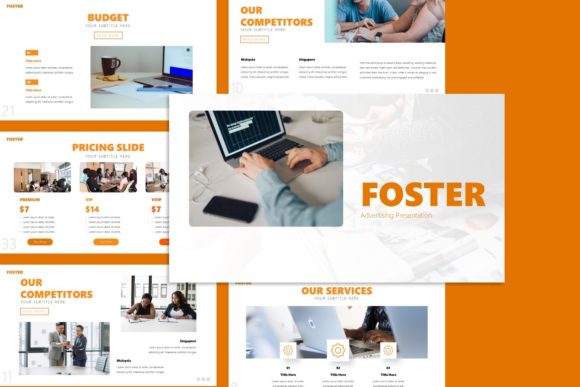
Beyond aesthetic considerations, the practical utility of a presentation template is defined by its technical construction. Professionals must evaluate how well a tool integrates into existing workflows and whether it adheres to modern design standards. The Foster Advertising Presentation exemplifies several key technical features that enhance productivity.
- Master Slide Architecture: The foundation of any efficient presentation file is the Master Slide system. This feature ensures that global changes—such as logo placement, color palette adjustments, or font hierarchy updates—propagate instantly across all 35 slides. This eliminates the tedious process of formatting individual pages and ensures consistency throughout the document.
- Vector-Based Scalability: All graphics within the template are fully resizable and editable vectors. This is critical for multi-format delivery. A slide designed for a standard 16:9 projector may need to be repurposed for social media stories or printed handouts. Vector integrity ensures that lines remain crisp and text remains legible regardless of the output resolution or physical size.
- Drag-and-Drop Efficiency: Time management is a tangible metric of success in business. Picture placeholders that support drag-and-drop functionality reduce the friction associated with image insertion. Users do not need to manually crop, mask, or align photos; the template’s pre-defined containers handle the spatial logic automatically.
- Editable Infographics: Data visualization is often the most time-consuming aspect of deck creation. Handcrafted infographics that are native to PowerPoint allow users to modify charts, graphs, and process diagrams directly within the software. There is no need to export to third-party vector software and re-import, which streamlines the revision cycle significantly.
The Role of Visual Consistency in Audience Retention
Cognitive psychology plays a significant role in why structured templates outperform ad-hoc designs. When an audience views a presentation, they are subconsciously building a mental model of the information hierarchy. Consistent visual cues reduce cognitive load, allowing viewers to process new information more rapidly.
A dedicated Presentation Template - Advertising provides this consistency through standardized spacing, aligned grids, and recurring motif elements. For example, if a specific color denotes "growth" in one slide, using that same color for positive metrics in subsequent slides reinforces the association. This semantic consistency is difficult to achieve when designing slides individually but is intrinsic to a well-crafted master slide system. Furthermore, pixel-perfect illustrations prevent the subconscious devaluation of content that occurs when audiences encounter blurry or misaligned graphics. High-fidelity visuals signal professionalism and competence, traits that are transferable to the presenter's actual services or products.
Navigating File Assets and Licensing Considerations
Understanding what is included in a digital asset package is essential for avoiding workflow bottlenecks. When utilizing this specific template, users should be aware of the distinct components provided and how they interact.
The PPTX Ecosystem
The core deliverable is the PowerPoint .PPTX file, which serves as the editable canvas. However, the accompanying Documentation File is equally important. It acts as a user manual for the design system, explaining how to unlock specific features, change color themes globally, or utilize hidden layout options. Skipping this documentation often leads to underutilization of the template’s capabilities.
Vector Icons and Graphic Resources
The inclusion of vector icons extends the template's lifespan. As business needs evolve, presenters may require symbols not originally featured in the demo. Having a compatible icon set ensures that new additions match the stroke weight, style, and visual tone of the existing slides. This maintains the integrity of the design system even as content expands beyond the initial scope.
Image Licensing and Preview Limitations
A critical consideration for all users is the distinction between template structure and preview content. All images seen in demonstration versions are for preview purposes only and are not included in the downloadable files. This is a standard industry practice rooted in copyright law. Professionals must budget time and resources for sourcing their own high-quality photography or licensing stock assets. Relying on low-resolution placeholders or watermarked previews in a final client presentation undermines the value of the premium template structure. Sourcing authentic, high-resolution imagery that aligns with the template’s designated picture placeholders is the final step in transforming a generic asset into a bespoke communication tool.
Strategic Customization for Maximum Impact
While the template provides the skeleton, the strategic application determines the effectiveness of the final output. Users should approach customization not just as an aesthetic choice, but as a messaging optimization process.
- Audit Content Before Design: Before opening the PPTX file, outline the narrative arc. Identify which of the 35 slides best correspond to each section of the story. Not every slide needs to be used; selecting the most appropriate layouts is more effective than forcing content into ill-fitting designs.
- Adapt Color Psychology: While the template comes with preset colors, adapting them to match specific campaign emotions or brand guidelines is vital. Blue may convey trust for a financial pitch, while vibrant orange might better suit a creative agency portfolio. Use the master slide controls to implement these changes systematically.
- Balance Text and Negative Space: Advertising templates are designed with ample negative space to create visual breathing room. Resist the urge to fill every corner with text. The power of these layouts lies in their restraint. If a slide feels crowded, split the content across two slides or move detailed information to speaker notes or supplementary handouts.
- Leverage Typography Hierarchy: The template’s font choices are intentional. Maintain the established hierarchy between headers, subheaders, and body text. Altering font sizes arbitrarily disrupts the visual rhythm. If emphasis is needed, utilize bold weights or color accents rather than increasing point size beyond the designed parameters.
Evaluating Long-Term Value and Reusability
The true measure of a presentation asset is its longevity. A high-quality Presentation Template - Advertising should not be a single-use item but a foundational element of a broader visual identity system. Because the graphics are editable and the master slides are comprehensive, organizations can create multiple variations for different departments or clients while maintaining a recognizable thread of quality.
For educators and researchers, this reusability translates to semester-oversemester efficiency. Course materials can be updated annually without redesigning lecture slides. For businesses, quarterly reports can maintain a consistent look that aids in year-over-year comparison. The initial time invested in learning the template’s intricacies pays dividends across dozens of future projects. By treating the template as a living design system rather than a static collection of slides, professionals unlock a sustainable workflow that supports both creative excellence and operational scalability.