Balconet Architecture Presentation: A Structural Framework for Modern Visual Communication
In the contemporary landscape of digital communication, the distinction between architectural design and information architecture has become increasingly blurred. Professionals across diverse sectors require tools that offer both structural integrity and aesthetic flexibility. The Balconet Architecture Presentation serves as a prime example of this convergence, functioning not merely as a slide deck but as a comprehensive visual system designed to organize complex narratives. Whether utilized by a creative agency refining a pitch or a researcher presenting data-heavy findings, this template ecosystem provides a foundational grid upon which unique stories can be constructed without the friction of starting from zero.
The Role of Master Slides in Scalable Design Systems
At the core of any robust presentation framework lies the concept of the master slide. In the context of the Balconet Architecture Presentation, this feature transcends simple background formatting. It acts as the genetic code for the entire document, ensuring consistency across all 35 included slides. For business owners and corporate teams, this architectural approach to PowerPoint design is critical for maintaining brand integrity. When a change is made to a master element—such as a logo placement, font hierarchy, or color palette—it propagates instantly throughout the deck. This global control mechanism reduces the cognitive load on the presenter, allowing them to focus on content strategy rather than manual alignment adjustments.
This systematic approach is particularly valuable for organizations managing multiple departments or clients. A marketing team might utilize one variation of the master slide for external campaigns, while an internal HR department uses another for training modules, yet both remain tethered to the same underlying visual language. The handcrafted nature of these infographics ensures that even when scaled across dozens of slides, the design retains a bespoke quality often lost in generic template packs. By leveraging master slides effectively, users transform a static file into a dynamic branding asset that adapts to specific communicative needs while preserving professional standards.
Cross-Industry Applications and Narrative Flexibility
Versatility is a defining characteristic of effective design tools, and the Balconet Architecture Presentation demonstrates this through its broad applicability. While the name suggests a focus on built environments, the structural logic of the template makes it equally suitable for non-architectural disciplines. Understanding how different sectors leverage this tool reveals its true utility beyond surface-level aesthetics.
- Creative Agencies and Portfolios: For visual professionals, the template serves as a digital gallery. The picture placeholders are engineered with drag-and-drop functionality, allowing photographers and designers to swap imagery rapidly without breaking the layout’s aspect ratio. This is essential for portfolio reviews where the work must take center stage against a clean, unobtrusive backdrop.
- Startups and Pitch Decks: Early-stage companies often struggle to articulate complex business models succinctly. The pre-designed infographic slides within this system provide visual metaphors for growth, market segmentation, and financial projections. Instead of spending hours drawing charts, founders can populate existing vector-based structures, ensuring their pitch looks polished and investor-ready.
- Corporate and Business Profiles: Established enterprises require templates that convey stability and clarity. The Balconet system offers structured layouts for company overviews, team introductions, and service breakdowns. These slides prioritize readability and information hierarchy, making them ideal for annual reports or stakeholder updates where data comprehension is paramount.
- Educators and Researchers: Academic presentations often suffer from text density. This template encourages the visualization of concepts through editable graphics. Researchers can adapt the handcrafted infographics to illustrate methodologies or theoretical frameworks, making dense information more accessible to students or conference attendees.
Technical Specifications and Asset Management
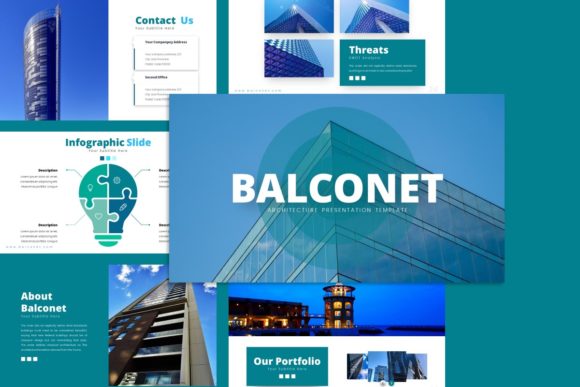
Beyond visual appeal, the practical value of a presentation template is determined by its technical construction and asset inclusion. The Balconet Architecture Presentation is delivered as a .PPTX file, ensuring compatibility with industry-standard software. However, the inclusion of supplementary files significantly enhances its long-term usability. The package includes a documentation file, which serves as a user manual for navigating the template’s advanced features. For users unfamiliar with master slide editing or vector manipulation, this guide bridges the gap between downloading the file and achieving professional results.
Furthermore, the inclusion of vector icons is a critical technical advantage. Unlike raster images that pixelate when resized, vector graphics maintain crisp edges at any scale. This allows users to resize illustrations to fit custom layouts without degrading visual quality. All graphics within the template are fully editable, meaning colors, shapes, and sizes can be modified to match specific brand guidelines. This level of customization distinguishes professional-grade templates from basic consumer options. It is important to note, however, that preview images are excluded from the download. Users must supply their own photography, which reinforces the template’s role as a structural vessel rather than a finished product. This separation of content and container ensures legal compliance and encourages original storytelling.
Optimizing Workflow Through Editable Infographics
Data visualization remains one of the most challenging aspects of presentation design. Creating custom infographics from scratch requires significant time and specialized design skills. The Balconet Architecture Presentation addresses this bottleneck by providing handcrafted infographics that are native to PowerPoint. Because these elements are built using standard shapes and grouping tools rather than embedded images, they remain fully editable within the software environment.
This editability transforms the workflow for analysts and project managers. Rather than exporting charts from Excel and pasting them as static pictures, users can adjust data points directly within the slide. If a quarterly figure changes days before a meeting, the graphic can be updated in seconds without returning to external design software. This agility is vital in fast-paced business environments where information is fluid. Additionally, the pixel-perfect nature of these illustrations ensures that even after modification, the visual balance remains intact. The template essentially democratizes high-end data design, making it accessible to professionals who may not have formal graphic design training but still need to communicate insights effectively.
Strategic Considerations for Template Implementation
While the Balconet Architecture Presentation offers extensive capabilities, maximizing its potential requires strategic consideration. Users should approach the template as a starting point rather than a final destination. The 35-slide count provides ample variety, but not every slide will be relevant to every project. Curating the selection to include only those layouts that support the specific narrative arc is essential for maintaining audience engagement. Overstuffing a presentation with unused features simply because they are available can dilute the core message.
Another key consideration is the balance between template structure and unique content. The risk with any popular template is creating a presentation that looks identical to others. To mitigate this, users should heavily leverage the customizable aspects—changing color schemes, adjusting typography, and integrating proprietary photography. The goal is to make the Balconet framework invisible, allowing the content to shine while benefiting from the underlying structural support. For personal portfolios, this means ensuring the template enhances rather than overshadows individual artistic voice. For corporate users, it means aligning the template’s modern aesthetic with established brand identity systems.
Enhancing Audience Engagement Through Visual Hierarchy
Ultimately, the success of any presentation is measured by audience retention and understanding. The architectural principles embedded in this template facilitate better cognitive processing. By utilizing consistent spacing, aligned grids, and clear typographic hierarchies, the design guides the viewer’s eye through the content in a logical sequence. This reduces mental fatigue and allows the audience to focus on the speaker’s message rather than deciphering chaotic layouts.
The drag-and-drop picture placeholders play a significant role here as well. They encourage the use of high-quality, relevant imagery over bullet points. Visual memory is stronger than textual memory; therefore, replacing lists with conceptual images supported by the template’s layout can significantly improve recall. For educators and trainers, this translates to better learning outcomes. For sales professionals, it means more persuasive pitches. The Balconet Architecture Presentation, therefore, functions as a pedagogical and rhetorical tool, structuring information in a way that aligns with how human beings naturally process visual stimuli. By respecting these design fundamentals, users ensure that their presentations are not only beautiful but also functionally superior in achieving their communicative objectives.