Visualizing Global Workforces with a Set of 600 Different Avatars
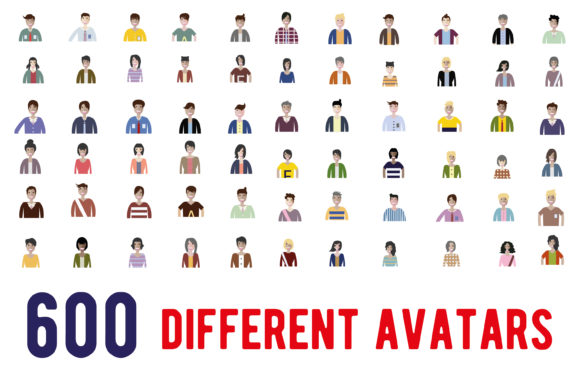
In the current landscape of digital communication, visual representation is no longer an afterthought; it is a fundamental component of user experience and brand identity. As organizations strive to reflect genuine diversity and inclusivity in their marketing, educational materials, and internal communications, the demand for comprehensive visual libraries has surged. A Set of 600 Different Avatars featuring business men and women icons represents more than just a graphic asset pack; it serves as a strategic tool for depicting the complexity of modern professional environments. This extensive collection, characterized by flat style design and diverse nationalities, addresses the critical need for authentic representation across various digital touchpoints.
The Strategic Value of Comprehensive Avatar Libraries
When designing for a global or diverse audience, relying on generic or limited stock imagery can inadvertently signal exclusion. The primary advantage of utilizing a massive repository of 600 unique characters lies in the granularity of choice. Unlike smaller packs where designers must compromise on specific demographics, a library of this magnitude allows for precise matching between visual content and target audience demographics. This specificity enhances relatability, which is a key driver in engagement metrics for everything from corporate training modules to consumer-facing applications.
Furthermore, the consistency of a unified art style cannot be overstated. When sourcing individual images from disparate creators, maintaining visual cohesion is nearly impossible. A dedicated set ensures that every businessman and woman icon shares the same line weight, color palette, and stylistic nuances. This uniformity is essential for building a recognizable brand language. Whether these assets are used in a slide deck, a mobile app interface, or an infographic, the flat style design ensures they integrate seamlessly without competing with other UI elements or text-heavy content.
Technical Versatility: Vector Files vs. JPEG Previews
The utility of any digital asset is defined by its technical flexibility. This collection distinguishes itself by providing both vector files and raster previews, catering to different stages of the creative workflow. Understanding when and how to use each format is crucial for maximizing the value of the set.
- Vector Files (AI, EPS, SVG): These are the master assets for professional designers. Because vectors are mathematically defined rather than pixel-based, they can be scaled infinitely without loss of quality. This makes them indispensable for large-format printing, responsive web design, and high-resolution displays. More importantly, vector formats allow for direct editing. Designers can modify colors to match brand guidelines, adjust clothing details, or combine elements from different avatars to create entirely new characters.
- JPEG Previews: While not suitable for final production, the five included JPEG preview files serve a vital logistical purpose. They allow stakeholders, clients, and team members to quickly browse and select assets without requiring specialized software like Adobe Illustrator. This streamlines the approval process and facilitates rapid prototyping during the ideation phase.
Applications Across Professional Sectors
The breadth of a 600-avatar collection enables application across a wide spectrum of industries. The inclusion of different nationalities and professional attire makes this set particularly relevant for sectors that rely on human-centric storytelling.
Corporate Training and Human Resources
Internal communications often struggle with engagement. Traditional e-learning modules featuring text-heavy slides see low completion rates. By integrating diverse working people icons into training scenarios, HR departments can create immersive narratives that reflect their actual workforce. For compliance training, onboarding processes, or leadership development, seeing oneself represented in the material increases retention and signals organizational commitment to inclusivity. The flat design aesthetic keeps the focus on the learning objectives rather than distracting photorealistic details.
User Experience and Interface Design
In product design, avatars function as wayfinding tools and personalization markers. A SaaS platform serving international markets benefits immensely from having a deep pool of culturally distinct avatars for user profiles, empty states, or onboarding tutorials. When a user encounters an avatar that resonates with their identity during the sign-up process, it reduces friction and builds immediate trust. Additionally, the flat style is inherently optimized for screens, loading quickly and remaining legible at small sizes within navigation bars or comment sections.
Educational Content and E-Learning
Educators and instructional designers face the challenge of making abstract concepts tangible. A diverse set of business and professional characters allows for the creation of case studies, role-playing scenarios, and visual explanations that transcend cultural barriers. In academic research presentations or K-12 career exploration materials, these avatars help visualize future possibilities for students from all backgrounds. The ability to edit vector files means educators can adapt characters to fit specific historical contexts, regional dress codes, or industry-specific uniforms.
Navigating Representation and Inclusivity
Possessing a large volume of assets does not automatically guarantee inclusive design. The effectiveness of a Set of 600 Different Avatars depends entirely on intentional implementation. Designers and content strategists must approach selection with cultural competence and awareness.
Authentic representation goes beyond skin tone. It encompasses hairstyles, facial features, accessories, and clothing that accurately reflect specific cultures without resorting to caricature. When utilizing this set, professionals should audit their selections to ensure they are not reinforcing stereotypes. For example, ensuring that leadership roles in infographics are depicted with diverse avatars, rather than defaulting to a single demographic for authority figures, is a subtle but powerful way to communicate equity.
Moreover, the sheer size of the library supports intersectionality. With 600 variations, it becomes feasible to represent combinations of identities—different ages, genders, ethnicities, and professional roles—that are often overlooked in smaller asset packs. This depth allows organizations to move beyond tokenism toward genuine reflection of the multifaceted nature of their communities and customer bases.
Optimizing Workflow with Infographic Elements
The inclusion of infographic elements alongside character avatars transforms this set from a simple illustration pack into a comprehensive data visualization toolkit. Business communication frequently requires translating complex datasets into digestible visuals. Having characters that stylistically match charts, graphs, and icons creates a unified narrative flow.
- Contextualization: Use avatars to personify data points. Instead of a generic bar chart showing employee satisfaction by region, pair each bar with an avatar representing that demographic to add human context to the statistics.
- Process Visualization: In workflow diagrams, replace standard geometric shapes with character icons to indicate human touchpoints. This clarifies where user interaction occurs versus automated system processes.
- Hierarchy and Emphasis: Utilize the flat design’s clean lines to guide the viewer’s eye. Avatars can serve as anchors in busy layouts, breaking up dense text and providing visual rest points that improve overall readability.
Considerations for Implementation and Licensing
While the creative potential is vast, practical considerations regarding file management and usage rights remain paramount. Managing 600 individual assets requires a robust organizational system. Teams should establish naming conventions and tagging protocols immediately upon acquisition to prevent the library from becoming unsearchable. Categorizing by attributes such as gender, ethnicity, profession, and expression will save countless hours during future projects.
Licensing terms also dictate the scope of permissible use. Users must verify whether the license covers commercial distribution, modification, and multi-seat usage. For agencies working on behalf of multiple clients, understanding transferability is essential. Additionally, while the vector files offer editability, teams should establish internal style guides to prevent the avatars from being modified in ways that could be deemed offensive or inconsistent with the original artist’s intent.
Future-Proofing Visual Assets
The digital landscape evolves rapidly, and so do standards for representation. A significant advantage of owning editable vector files is the ability to update assets over time. As societal norms shift or as an organization expands into new regions, designers can adapt existing avatars rather than commissioning entirely new illustrations. This longevity makes the initial investment in a comprehensive set like this far more cost-effective than piecemeal purchasing.
Ultimately, the decision to utilize a Set of 600 Different Avatars is a decision to prioritize quality, consistency, and inclusivity in visual communication. By leveraging the technical benefits of vector formats and the narrative power of diverse representation, professionals across industries can create content that is not only visually appealing but also deeply resonant with their audiences. The combination of businessman and woman icons, varied nationalities, and supporting infographic elements provides a foundational vocabulary for telling richer, more accurate stories about the modern world of work.