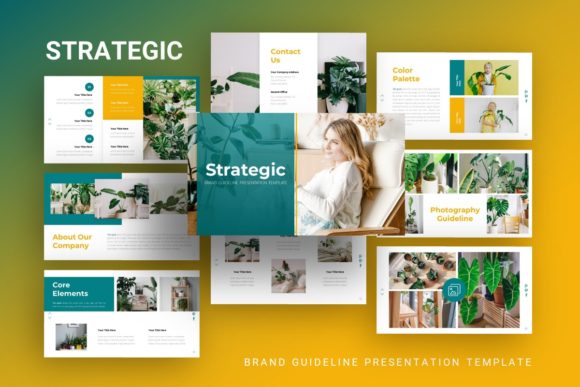
Strategic Presentation Templates: Elevating Brand Guidelines and Corporate Narratives
In the modern business landscape, the distinction between a simple slide deck and a strategic communication tool is often what separates successful pitches from forgotten meetings. Visual consistency is not merely an aesthetic choice; it is a fundamental component of brand equity and operational efficiency. For creative agencies, startups, corporate entities, and individual professionals, the ability to deploy a cohesive visual narrative quickly is paramount. This necessity has driven the evolution of high-quality presentation frameworks, specifically the Presentation Template - Strategic, which serves as a comprehensive foundation for introducing brand guidelines and corporate identities.
The Role of Master Slides in Visual Consistency
At the core of any professional presentation system lies the concept of the Master Slide. Unlike standard slides where formatting is applied individually, master slides act as the genetic code for the entire deck. When utilizing a robust template designed for strategic purposes, users gain access to pre-defined layouts that enforce typographic hierarchy, color palette adherence, and spatial balance automatically. This technical infrastructure ensures that whether a user is creating a company profile or a personal portfolio, the output remains pixel-perfect without requiring manual adjustment on every page.
The advantage of this architecture extends beyond aesthetics. It significantly reduces the cognitive load on the presenter. Instead of worrying about alignment or font sizes during the content creation phase, professionals can focus entirely on the narrative arc and data integrity. For organizations managing multiple teams or departments, master slides serve as a guardrail, preventing brand dilution while allowing for necessary customization. This balance between rigid structure and flexible content is what defines a truly strategic asset in digital communications.
Customization Capabilities for Diverse Industries
Versatility is a key metric when evaluating presentation resources. A template restricted to a single industry limits its long-term utility. The Presentation Template - Strategic addresses this by offering 35 distinct slides tailored for various applications, ranging from pitch decks for venture capital meetings to photography portfolios for visual artists. This breadth allows the file to function as a universal design system rather than a static document.
- Creative Agencies: Can utilize handcrafted infographics to visualize complex campaign data or workflow processes for clients.
- Startups and Pitch Decks: Benefit from structured problem-solution slides and market analysis layouts that follow investor expectations.
- Corporate Business: Use clean, minimalist slides for quarterly reports, internal training, and stakeholder updates.
- Personal Portfolios: Leverage image-heavy layouts with drag-and-drop placeholders to showcase work samples professionally.
- Educators and Researchers: Adapt infographic elements to explain academic concepts or research findings visually.
This adaptability stems from the editable nature of the vector graphics and illustrations included within the file. Because these elements are not flattened images, they can be resized, recolored, and reshaped to fit specific contextual needs without losing resolution. This feature is particularly critical for print-ready presentations or displays on high-definition screens where pixelation would undermine credibility.
Visualizing Data Through Handcrafted Infographics
Data visualization is often the breaking point for many presentations. Standard charting tools in presentation software frequently produce generic outputs that fail to engage audiences or align with brand identity. Strategic templates differentiate themselves by including handcrafted infographics built directly within PowerPoint. These are not external imports but native objects that remain fully editable.
The inclusion of custom infographic elements transforms raw statistics into compelling stories. For example, a startup explaining user growth can move beyond a simple line graph to use a stylized, branded timeline that reinforces their market position. Similarly, a corporate entity outlining sustainability goals can use icon-driven process diagrams that make abstract targets tangible. Since these graphics are based on vector technology, they scale infinitely, ensuring clarity regardless of the projection size or device used for viewing.
Furthermore, the integration of a dedicated vector icon set complements these infographics. Icons serve as visual anchors, helping audiences scan slides and retain information more effectively than text alone. Having a cohesive icon library included in the documentation file eliminates the common design friction of sourcing mismatched icons from disparate websites, thereby maintaining visual harmony throughout the deck.
Technical Specifications and File Management
Understanding the technical composition of a presentation template is essential for seamless implementation. The Presentation Template - Strategic is delivered as a .PPTX file, ensuring compatibility with Microsoft PowerPoint, which remains the industry standard for business communications. Accompanying the main file is a documentation guide, which serves as a user manual for navigating the master slides and understanding the layering of graphic elements.
Users should note a critical distinction regarding media assets: all images seen in preview demonstrations are for illustrative purposes only and are not included in the downloadable files. This is a standard practice in digital asset distribution due to licensing restrictions. However, the template compensates for this through intuitive picture placeholders. These smart objects allow users to simply drag and drop their own licensed or original photography into designated areas, automatically cropping and masking the image to fit the layout perfectly. This workflow streamlines the personalization process, making it accessible even to those with limited graphic design experience.
Implementing Brand Guidelines Effectively
One of the most significant use cases for this type of template is the introduction of strategic brand guidelines. When a company rebrands or launches a new visual identity, the guideline presentation itself must exemplify the standards it seeks to establish. Using a disorganized or outdated deck to present new brand rules creates immediate dissonance.
A strategic template provides the necessary scaffolding to articulate brand values, typography systems, color usage, and tone of voice clearly. The 35-slide variety ensures there is ample room to cover both macro-level strategy and micro-level execution details. For instance, specific slides can be dedicated to showing correct versus incorrect logo usage, while others can demonstrate the application of the color palette across different media. By leveraging the resizable and editable graphic features, brand managers can create bespoke examples that resonate specifically with their internal teams or external partners.
This approach turns the brand guideline presentation from a passive PDF document into an active, engaging workshop tool. The interactive nature of a live presentation, supported by high-quality visuals, increases retention and buy-in from stakeholders. It demonstrates professionalism and attention to detail, reinforcing the authority of the brand team.
Optimizing Workflow for Non-Designers
While professional designers appreciate the structural integrity of master slides, the true value of a strategic presentation template often lies in its accessibility to non-designers. In many organizations, marketing managers, sales representatives, and executives must create decks independently. Without a robust template, these users often resort to breaking brand rules in an effort to make content fit, resulting in inconsistent collateral.
The drag-and-drop functionality and pre-set layouts democratize good design. Users do not need to understand kerning, white space ratios, or color theory to produce a polished result; they simply need to select the appropriate slide from the master library and insert their content. This efficiency is vital in fast-paced environments where speed-to-market is as important as quality. The template acts as an automated art director, guiding the user toward acceptable outcomes while minimizing the risk of error.
Additionally, the pixel-perfect illustrations provide a level of polish that stock photos cannot achieve. Illustrations tend to age better than photography and offer a more distinctive brand personality. Because they are integrated into the file, they eliminate the need for separate asset management, keeping the project organized and portable. This consolidation of resources simplifies version control and collaboration, as team members can share a single source of truth for presentation design.
Considerations for Selection and Usage
When adopting a Presentation Template - Strategic, users should evaluate their specific requirements against the template's capabilities. While the 35-slide count offers significant variety, it is important to audit the specific slide types to ensure they match the intended narrative flow. A pitch deck requires different structural elements than a photography portfolio, and while the template supports both, the user must curate the selection to avoid a disjointed experience.
It is also advisable to review the documentation file immediately upon acquisition. Understanding how the master slides are constructed prevents accidental modifications that could disrupt the global styling. Investing time in learning the template’s logic upfront pays dividends in long-term efficiency. Furthermore, because images are excluded, users should prepare their visual assets in advance to avoid bottlenecks during the final assembly phase.
Ultimately, the effectiveness of any presentation tool depends on the quality of the content placed within it. A strategic template enhances delivery but does not replace the need for clear messaging, rigorous data analysis, and audience empathy. It is a vessel for ideas, optimized to reduce friction and maximize impact. By treating the template as a strategic partner rather than just a decorative skin, professionals across industries can elevate their communication standards and present their work with the confidence that comes from knowing their visual foundation is solid, scalable, and professionally crafted.