Elevating Visual Communication: A Comprehensive Guide to the Munchies Culinary Presentation Template
In the modern digital landscape, the ability to communicate ideas visually is just as critical as the ideas themselves. Whether you are pitching a startup to venture capitalists, showcasing a photography portfolio, or presenting a quarterly corporate report, the design of your presentation dictates how your message is received. This is where specialized tools like the Munchies Culinary Presentation Template bridge the gap between raw data and compelling storytelling. While the name suggests a niche focus on food and dining, this template serves as a masterclass in versatile visual communication, applicable to creative agencies, business profiles, and personal portfolios alike.
Understanding how to leverage a high-quality presentation template is essential for professionals who need to save time without sacrificing aesthetic integrity. This guide explores the purpose, features, and practical applications of the Munchies template, helping both beginners and experienced presenters understand why structured design systems are vital for success in today’s fast-paced environment.
The Significance of Professional Presentation Design
Before diving into specific features, it is important to understand why templates like Munchies exist. In an era of information overload, audiences have shorter attention spans and higher expectations for visual quality. A slide deck is no longer just a backdrop for a speaker; it is a standalone marketing asset, a leave-behind document, and a reflection of brand identity.
Many individuals mistakenly believe that using a template limits creativity or results in generic output. On the contrary, a well-crafted template provides a foundation that enhances creativity by removing the friction of layout design. When you do not have to worry about alignment, color consistency, or font pairing, you can focus entirely on narrative flow and content strategy. The Munchies template exemplifies this philosophy by offering a structured yet flexible framework that adapts to various industries beyond its culinary namesake.
Versatility Across Industries and Use Cases
Although branded as a "Culinary Presentation," the architectural design of the Munchies template makes it remarkably adaptable. Good design is universal; clean lines, appetizing color palettes, and organized grids work just as well for tech startups as they do for restaurants. Here is how this template fits into different professional contexts:
Creative Agencies and Portfolios
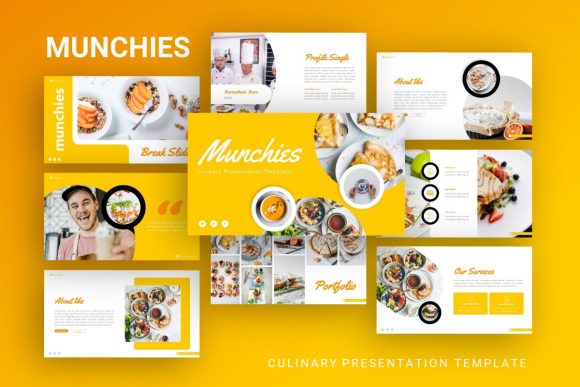
For designers, photographers, and artists, the portfolio is the primary tool for securing work. The Munchies template includes dedicated layouts for image-heavy content. The picture placeholders allow for drag-and-drop functionality, making it easy to swap preview images with actual project work. Because the illustrations are pixel-perfect and resizable, creatives can maintain high-resolution standards whether presenting on a 4K monitor or printing handouts for potential clients.
Corporate Business and Company Profiles
In the corporate world, clarity is king. Stakeholders need to digest complex information quickly. The template’s handcrafted infographics serve this purpose by transforming dry statistics into engaging visual narratives. For company profiles, the consistent use of master slides ensures that every department’s section looks cohesive, reinforcing brand professionalism during internal meetings or external partnerships.
Startups and Pitch Decks
Securing funding often hinges on the first impression. Investors review hundreds of decks, and those with superior visual hierarchy stand out. With 35 distinct slides, Munchies offers specific layouts for problem statements, market analysis, team introductions, and financial projections. This variety allows founders to build a comprehensive pitch deck without hiring an expensive design agency, democratizing access to top-tier presentation aesthetics.
Technical Features That Enhance Workflow
Beyond aesthetics, the true value of a presentation template lies in its usability. The Munchies template is engineered for efficiency, featuring technical specifications that cater to users of varying skill levels.
- Master Slide Architecture: The template is based on Master Slides, which is a crucial feature for scalability. Instead of formatting 35 slides individually, users can edit the Master Slide to apply global changes—such as logo placement, background colors, or typography—to the entire deck instantly. This ensures consistency and drastically reduces editing time.
- Handcrafted Infographics: Unlike generic clip art, these graphics are designed specifically for the template. They are fully editable vector elements within PowerPoint, meaning you can change colors, resize shapes, and adjust data points without losing quality or resorting to external software like Adobe Illustrator.
- Drag-and-Drop Placeholders: One of the most common frustrations in presentation design is managing images. The integrated picture placeholders streamline this process. Users simply drag their file onto the designated area, and the image automatically crops and masks to fit the layout perfectly.
- Comprehensive File Inclusion: The package includes the .PPTX file, documentation, and vector icons. Having vector icons included eliminates the need to hunt for matching assets online, ensuring that every graphical element shares the same visual language.
Clarifying Common Misunderstandings About Templates
When adopting a new design tool, users often encounter assumptions that can hinder their effectiveness. Addressing these misconceptions is key to getting the most out of the Munchies template.
Misconception: "The demo images are included."
It is vital to note that all images shown in the preview are for demonstration purposes only and are not included in the downloadable files. This is standard industry practice due to licensing restrictions. Users must supply their own photography. However, this actually benefits the user, as it encourages the use of authentic, original imagery rather than stock photos that might make the presentation feel impersonal.
Misconception: "I need advanced design skills to customize this."
Because the template relies on native PowerPoint features like Master Slides and shape editing, no third-party design software is required. If you can perform basic tasks in PowerPoint, you can fully customize this template. The included documentation file serves as a roadmap, guiding users through the customization process step-by-step.
Misconception: "Templates look repetitive."
Repetition occurs when users fail to utilize the full breadth of available assets. With 35 unique slides, Munchies provides enough variation to prevent visual fatigue. The key is to mix and match layouts strategically rather than defaulting to the same bullet-point slide repeatedly.
Integrating Design into Modern Workflows
The relevance of tools like Munchies extends beyond the final presentation; they influence how we organize thoughts. In remote and hybrid work environments, asynchronous communication is increasingly common. A well-designed slide deck often replaces a live meeting, serving as a memo or proposal that must be understood without a narrator.
Furthermore, the rise of personal branding has made presentation skills relevant for individuals, not just corporations. Job seekers, freelancers, and students use polished decks to differentiate themselves. A personal portfolio built on a robust template signals attention to detail and respect for the viewer's time. It demonstrates that the individual understands modern visual standards and possesses the technical competency to execute them.
Best Practices for Customization
To maximize the SEO and user-experience value of your presentation, consider these practical tips when using the Munchies template:
- Define Your Color Palette Early: Before adding content, update the Master Slides with your brand colors. This sets the tone immediately and prevents disjointed visuals later.
- Prioritize Hierarchy: Use the template’s typography styles to guide the eye. Headings should be distinct from body text, and key data points should be highlighted using the provided infographic elements.
- Leverage Negative Space: The template is designed with breathing room. Resist the urge to fill every pixel with text. White space improves readability and makes the content feel more premium.
- Test on Multiple Devices: Since presentations are viewed on everything from projectors to mobile phones, ensure your text remains legible and your resizable graphics maintain clarity at different scales.
Conclusion
The Munchies Culinary Presentation Template represents more than just a collection of attractive slides; it is a comprehensive system for visual communication. By combining 35 versatile layouts, handcrafted infographics, and user-friendly Master Slide architecture, it empowers users across creative, corporate, and personal domains to tell better stories. Whether you are launching a startup, profiling a company, or curating a portfolio, understanding and utilizing such tools is fundamental to succeeding in a visually driven world. By moving past common misconceptions and embracing the structural advantages of professional templates, anyone can elevate their presentations from functional to exceptional.